

Is Boutique Shopping Worth It? A 2026 Review
Table of Contents
- Is Boutique Shopping Worth It? The Honest Verdict
- Boutique Clothes vs. Fast Fashion: What You Actually Pay For
- How to Tell If an Online Boutique Is Legit
- Boutique Clothing Quality: How to Assess It Before You Buy
- Boutique Clothing Size Guide: Getting Fit Right Online
- When to Skip the Boutique: A Balanced Shopper Comparison
- Frequently Asked Questions
Last Updated: October 12, 2026
Is Boutique Shopping Worth It? The Honest Verdict
Boutique shopping is buying apparel and accessories from small, independently owned retailers that curate a limited selection rather than stocking everything in every size. At Peach and Pantry, we run a women-owned boutique, so we have a stake in this answer, but a boutique purchase only pays off when the piece gets worn for years, not weeks.
The verdict: boutique shopping is worth it when you buy fewer pieces that fit well and last, and not worth it when you are chasing a trend you will wear twice.
Boutique Clothes vs. Fast Fashion: What You Actually Pay For
The price gap between boutique clothing and fast fashion is real, and it is not all markup.
Small-batch clothing costs more per unit: a factory printing thousands of identical tops spreads setup costs across every unit, while a boutique ordering a few dozen pieces cannot.
What you pay for at a boutique is narrower and deeper: a curated selection, a considered fit, and staff who can tell you how a garment runs.
The Cost-Per-Wear Math
Cost per wear is the purchase price divided by the number of times you actually wear the item, the most useful number in this decision.
A cheap fast-fashion top that pills after four wears has a high cost per wear despite the low sticker price.
| Purchase | Price | Wears | Cost Per Wear |
|---|---|---|---|
| Fast-fashion top | Low | 4 | High |
| Mid-range top | Medium | 20 | Moderate |
| Boutique piece | Higher | 50+ | Low |
The table is unit-free because your numbers will differ. Fill in your own price and an honest wear estimate, then compare.
How to Tell If an Online Boutique Is Legit
An online boutique is legitimate when it publishes a real business identity, a clear return policy, and honest product photography. If you cannot find those three things in under two minutes, slow down.
Run this checklist before entering a card number anywhere:
- A physical mailing address or registered business name is listed
- A written return and exchange policy with a stated window
- Fabric content listed for each garment
Red Flags and Buyer Protections
The clearest red flag is a store that will not tell you who runs it.
Know your protections before you buy. In the United States, the Federal Trade Commission's guidance on online shopping explains your rights around misleading claims and undelivered orders.
A boutique that answers a sizing question by email within a day usually handles a return properly. Responsiveness before the sale predicts behavior after it.
Boutique Clothing Quality: How to Assess It Before You Buy
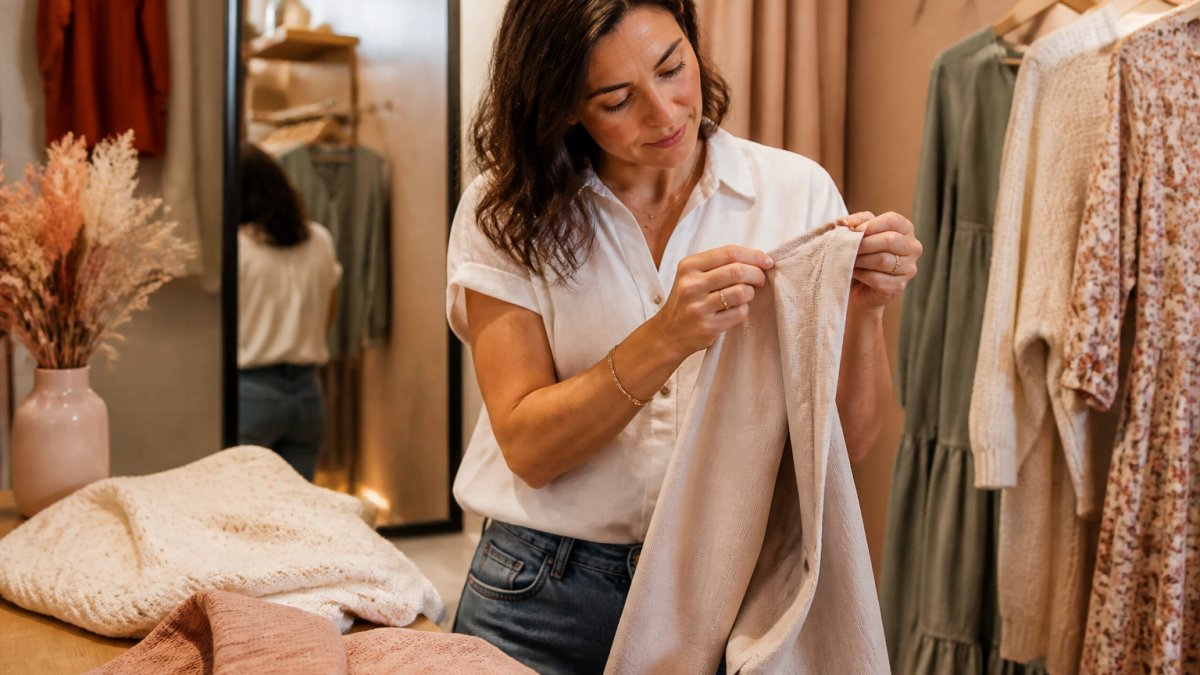
Boutique clothing quality comes down to three things you can check in a photo or in person: fabric content, seam construction, and how the garment is finished at the edges. Here is the method we use.
The 60-Second Fabric Check
Start with the fiber label, the most honest thing on a product page. A listing that names its blend, say, 95% cotton and 5% elastane, tells you something verifiable.
Then read the blend against the job the garment has to do:
- Cotton and linen breathe and hold up to repeated washing, but they wrinkle and can shrink if you ignore care instructions.
- Wool and wool blends resist odor and hold shape, which is why they often earn a lower cost per wear than their price suggests.
- Viscose, rayon, and modal drape beautifully but are weaker when wet, so they pill and stretch faster under hard wear.
Well-made boutique pieces usually have a short fiber list, two or three fibers, each doing a clear job. A long list of unpronounceable fibers usually means the fabric was engineered around cost, not wear.
How to Read Construction Without a Textile Degree
Seams are where a garment survives or fails, and you can judge them from a close-up photo. Ask the retailer for one if the product page only shows flat-lays.
What to look for:
- Stitch density: Dense, even stitching along a seam suggests the garment was assembled with care. Skipped stitches, loose threads, and puckered fabric are the opposite.
- Seam type: A flat-felled or French seam encloses the raw edge and is a mark of a garment built to be washed and worn. A raw, serged edge that you can see through is cheaper to produce and frays faster.
- Seam allowance: Generous allowance, the fabric left inside the seam, means a tailor can let a garment out or take it in. That extends its life and its fit range.
Turning Quality Into a Value Decision
Quality only matters if it changes the math. Two garments at the same price are not equal if one lasts three times as long, which is why a higher-priced boutique piece can be the cheaper purchase.
Before you buy, run three quick tests:
- The care test. If the care label says dry-clean-only and you know you will not, the garment's real cost includes cleaning or the risk of ruining it. A washable piece you actually maintain beats a delicate one you avoid wearing.
- The alteration test. If the fit is close but not perfect, does the construction allow a tailor to fix it? Generous seam allowance and simple lines make alterations cheap; complex construction makes them expensive or impossible.
- The return test. A generous, clearly written return window lowers the risk of buying a size or fabric you are unsure about. A policy buried in exceptions raises it. Value is not just the garment, it is the risk you take on when you buy it.
Where Boutique Quality Claims Need Scrutiny
"Small-batch" and "locally made" are production facts, not quality guarantees. A small run can still use cheap fabric, and a local maker can still cut corners. The same goes for sustainability: a short run reduces waste versus mass production, but does not by itself prove ethical labor or low-impact materials.
Faux Leather Braided Tote Bag →
Quality is checkable in about a minute. Fabric content, seam construction, and a clear return policy tell you more than any adjective on the page.
Boutique Clothing Size Guide: Getting Fit Right Online
The best way to get fit right online is to measure yourself, compare against the retailer's actual size chart, and read the fit notes on each product page.
Measure four things and write them down: bust, waist, hip, and preferred garment length. Match those numbers to the chart, not the letter on the tag.
We carry inclusive sizing from S through plus, and we publish a size chart on the site for exactly this reason.
| Measurement | How to Take It | Why It Matters |
|---|---|---|
| Bust | Around the fullest part | Determines top and dress fit |
| Waist | At the natural crease | Prevents gaping or pinching |
| Hip | Around the fullest point | Critical for pants and skirts |
| Length | Shoulder to hem on a similar item | Predicts where a hem lands |
When in doubt, ask. A quick message about whether a style runs small costs nothing and saves a return.
When to Skip the Boutique: A Balanced Shopper Comparison
A boutique is not the right answer for every purchase. The useful question is not "are boutiques good?" but "is a boutique the right channel for this specific buy?" The answer depends on your budget, how hard the item is to fit, the occasion, and how you prefer to shop.
Match the Purchase to the Channel
| Purchase situation | Boutique | Mass-market retail | Secondhand / resale |
|---|---|---|---|
| Building a long-term wardrobe | Strong, cost per wear favors quality | Weak, short lifespan | Good, if you can inspect fit |
| One-off event or trend piece | Weak, high cost per wear | Strong, low commitment | Strong, low price, low risk |
| Hard-to-fit sizing | Strong, real size charts, staff guidance | Mixed, broad but inconsistent | Mixed, depends on the seller |
| Bulk basics (tees, socks) | Weak, price and selection | Strong, cheap and available | Weak, inconsistent stock |
| Gift shopping | Strong, curation and presentation | Mixed, generic | Weak, hard to size |
| Need it tomorrow | Weak, limited stock, shipping time | Strong, in-store today | Weak, depends on the seller |
Read the table as trade-offs, not a verdict. A boutique wins when the piece needs to last, fit well, or feel distinctive. Mass-market retail wins when price, speed, and breadth matter more than longevity. Secondhand wins when you want a specific item cheaply and can verify its condition.
The Four Questions That Decide It
1. How many times will I wear this? If the honest answer is fewer than about ten, the boutique premium is hard to justify.
**2.
3. What is the occasion? A wedding guest dress you will wear once is a poor candidate for a premium purchase.
4. How do I actually like to shop? If you value browsing a curated selection and getting advice, a boutique delivers something mass-market retail does not.
When the Boutique Is the Smarter Buy
Choose the boutique when the piece needs to last, when fit matters, and when you want something you will not see on five other people. A boutique that answers sizing questions, publishes real measurements, and offers a clear return window lowers your risk enough that the higher price is often the better deal.
When to Skip It
Skip the boutique for one-off event pieces you will wear once, basics you replace constantly, and anything you need in a size or color the boutique does not stock. Mass-market retail genuinely wins on those, on speed, and on price when the item is disposable by nature.
Our own picks lean toward pieces that earn their cost per wear. The Faux Leather Braided Tote Bag at $51.99 is a structured daily carryall in a braided faux leather finish that works for the office and the weekend. For something roomier, the Braided Vegan Leather Tote Bag at $79.99 uses a shoulder-carry design and smooth vegan leather with braided detailing.


For a smaller everyday option, the Vegan Leather Rectangular Shoulder Bag at $52.99 has a clean rectangular silhouette and room for a wallet, phone, and keys. The Crochet Woven Hobo Bag at $70.99 offers a crochet-woven texture and detachable chain strap for handheld or crossbody wear. For warm-weather days, the Two Toned Straw Tote Bag at $62.99 is a lightweight straw-inspired build in a two-tone finish.

One caveat: a boutique tote is not the place to save money if you need a beater bag for a messy commute. Buy the piece you will actually carry.
Frequently Asked Questions
Is it worth buying clothes from an online boutique?
It depends on what you value. Boutique shopping typically costs more per item than mass-market retail, but the pieces are often produced in smaller runs with better fabric and construction. If you wear an item 30 or more times, a $60 piece works out to $2 per wear, which can beat a $20 fast-fashion top worn twice. The math favors boutiques when you buy pieces you will actually rewear.
How can you tell if an online boutique is legitimate?
Check for a real return policy, a working customer service contact, and reviews on independent sites rather than only on the store's own page. Look for clear sizing charts with measurements, not just S/M/L labels. A reputable retailer will list fabric content and care instructions. If a site has no return address, no phone number, and prices that seem too low, treat it as a risk.
Are boutique clothes better quality than clothes from big-box stores?
Not automatically. Boutique clothing quality varies, so assess each piece on fabric weight, seam finishing, and whether the garment holds its shape. Smaller brands often use better materials because they produce in small batches and can control sourcing. Big-box stores can also carry well-made items, but the volume model pushes toward thinner fabrics and faster turnover.
Why are boutique clothes more expensive?
Small-batch production costs more per unit. A boutique ordering 200 pieces pays a higher per-item cost than a chain ordering 20,000. Add in limited runs, independent designer margins, and often domestic or ethical manufacturing, and the price reflects those choices. The trade-off is fewer people wearing the same piece and often longer garment lifespan.
Do boutiques offer better customer service than larger retailers?
Often yes, because smaller teams can give personalized attention. Many boutiques offer styling advice, fit guidance, and direct answers about restocks. That said, service quality depends on the individual store. Check whether the boutique responds to questions before you order, and whether its return process is clear. Attentive staff is a real benefit when it exists, not a guarantee.